
The Jewish Community of Cuba at the 25th Maccabiah: History, Effort, and Victory
AR
To understand the significance of the Cuban delegation's participation in the 25th Maccabiah, we must go back to the origins of the Maccabean movement in Cuba. In 1938, the first youth organization with a sporting character emerged under the name Macabi, with members from the Sephardic synagogue Chevet Ahim and under the presidency of Rafael Behar. This initiative developed a cultural and sports program that laid the groundwork for what, decades later, would become a tradition of participation and community pride.
The Macabi Magazine, of which only three issues were published in 1942 under the direction of Julio Alghazi, documented those first steps of a movement that, although interrupted by historical circumstances, never lost its essence.
The path to the first participation
Cuba's history in the World Maccabiah is also a story of perseverance in the face of adversity. In 1993, the Jewish Community of Cuba received its first official invitation, but the Cuban government, through its institutions, did not authorize the departure of the athletes. It was in 1997, during the 15th Maccabiah, that Cuba achieved its first participation, although with only one athlete: Hella Eskenazi, in Karate-Do. That participation was marked by the impossibility of displaying the Cuban flag in the stadium due to a bridge accident during the opening ceremony, but Hella reached the final of the individual kata, leaving an indelible mark.
In 2005, at the 17th Maccabiah, Cuban softball player Manuel Said formed part of Venezuela's team, finishing in fourth place. However, it was in 2013, at the 19th Maccabiah, when the Jewish Community of Cuba attended for the first time as an official delegation, with 55 delegates who competed in five sports disciplines and obtained a gold medal, a silver medal, and a bronze medal in archery, as well as two bronzes in Karate-Do.
Abel Hernández Eskenazi: A witness to history
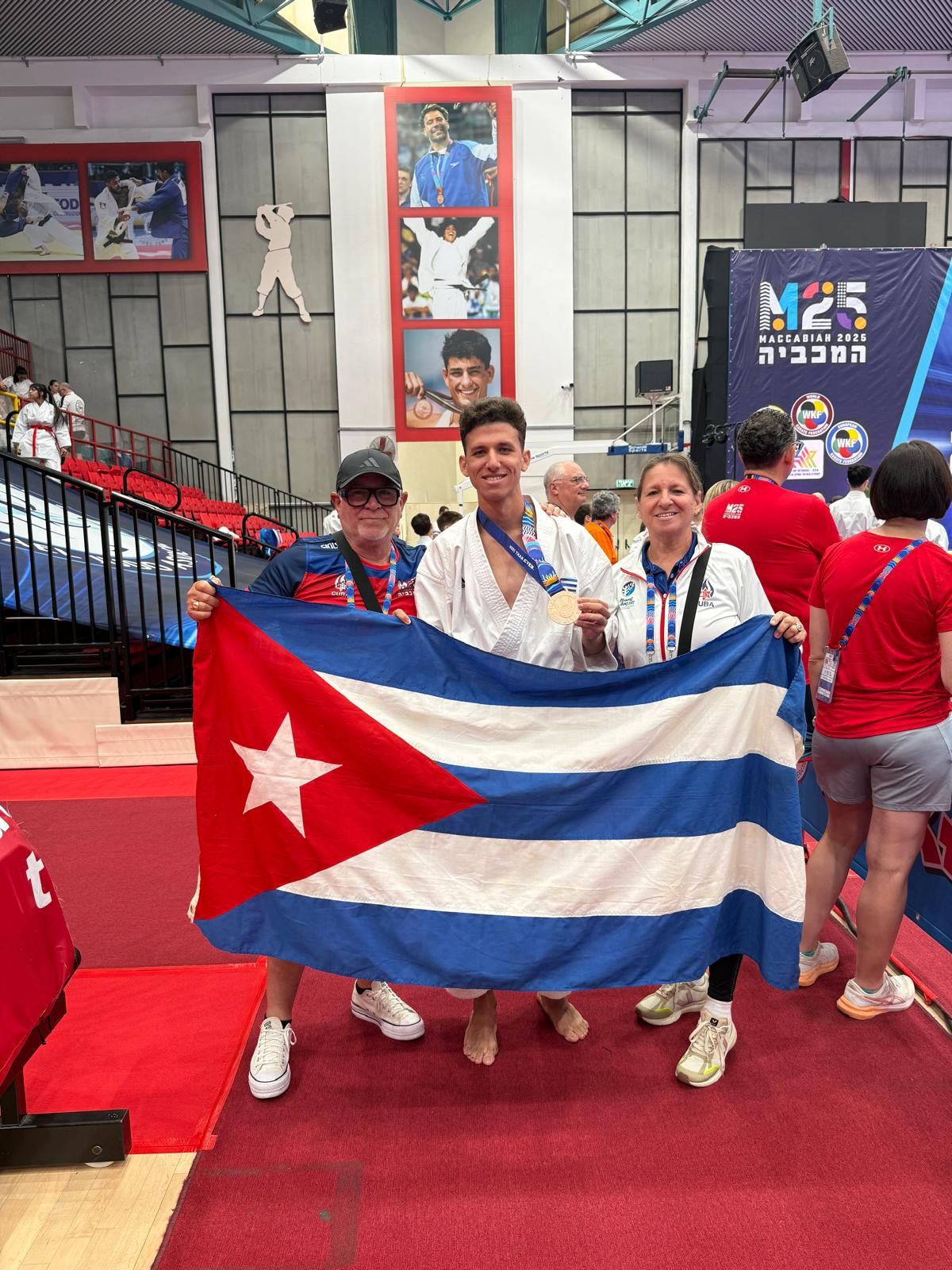
At the heart of this trajectory is Abel Hernández Eskenazi, an emblematic figure of the Maccabi Cuba project that was born in 2013. Abel has been a witness and protagonist of every step of this history, participating in all editions of the Maccabiah in the discipline of Karate-Do. His constant presence over the years represents continuity and an unwavering commitment to the values of the Maccabean movement.
Abel is not only an athlete but also the official guide of this project, Havana Jewish Tour, where he shares with travelers from around the world the rich history and daily life of the Jewish community in Cuba. His dual role as a medal-winning athlete and cultural guide makes him a living bridge between sport, identity, and community legacy.
At the 20th Maccabiah (2017), Cuba competed in Table Tennis, Futsal, Softball, Women's Volleyball, and Karate-Do, obtaining a gold medal and a bronze medal in Karate-Do. After the forced pause due to the pandemic, at the 21st Maccabiah, the delegation competed in Table Tennis, Softball, Women's Volleyball, 3x3 Basketball, and Karate-Do, achieving a bronze medal in the latter discipline.
Regional consolidation
The Cuban Maccabean movement has not only grown at the world level but also regionally. In 2015, during the XIII Pan American Maccabi Games in Chile, Cuba participated for the first time in regional games with teams in Table Tennis, Futsal, Women's Volleyball, and Karate-Do. In Mexico 2019, the Cuban delegation obtained four gold medals, one silver medal, and five bronze medals in Table Tennis. In 2023, in Buenos Aires, Maccabi Run was added as a new discipline, obtaining a silver medal and a bronze medal in its debut.
The 25th Maccabiah: A historic participation and sporting achievements in extreme Conditions
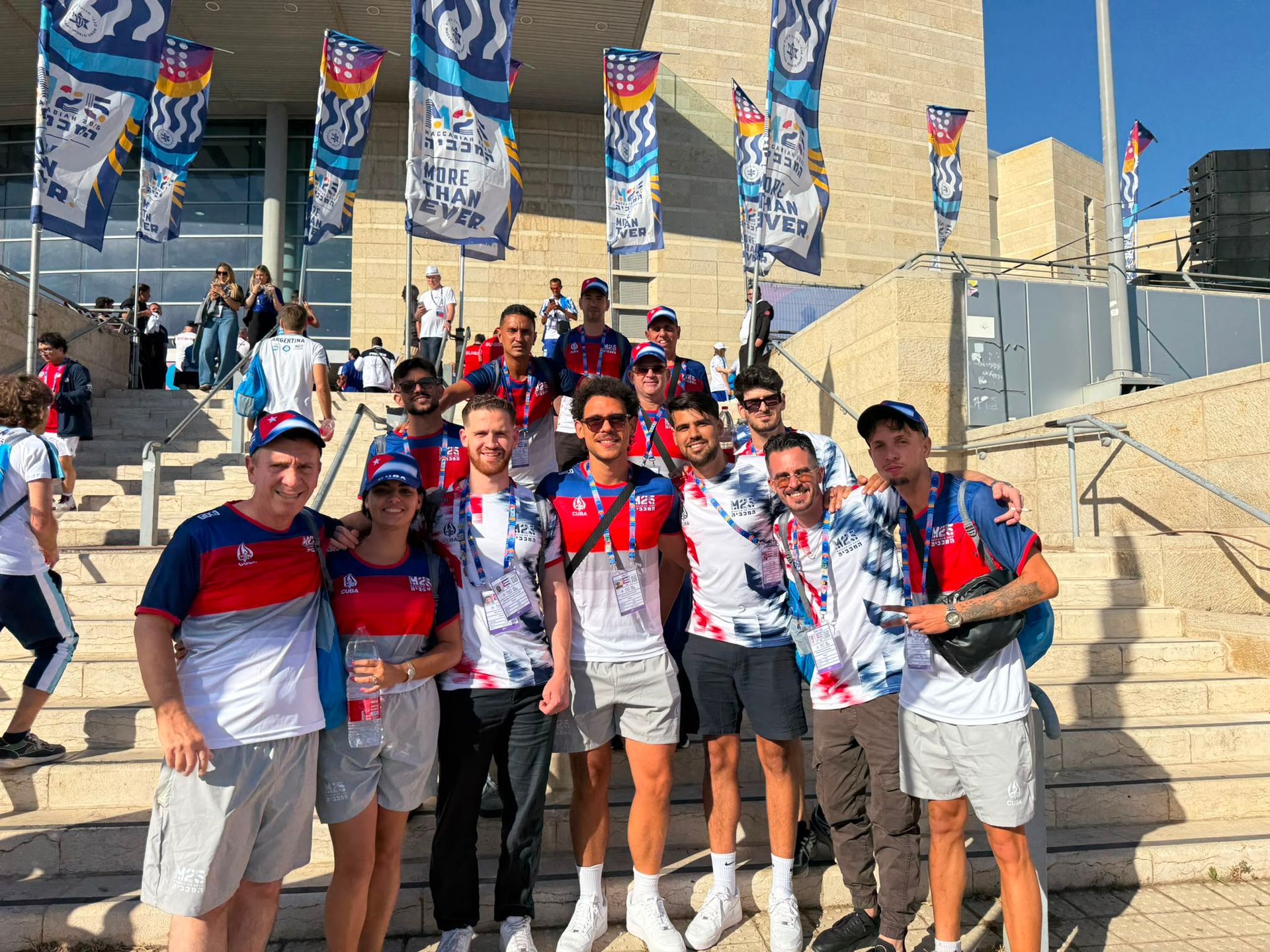
The 25th Maccabiah, postponed from 2025 to 2026 due to the conflict between Israel and Iran, represents the fifth consecutive participation of the Hebrew Community of Cuba. The delegation, made up of Cuban Jews from Cuba and Israel, competed in Chess, Athletics, Basketball, Futsal, Softball, Table Tennis, Tennis, and Karate-Do.
The opening ceremony, held on July 1 at Teddy Stadium in Jerusalem, saw the Cuban delegation parade with the national flag. Cuba's medal tally at these Maccabiah shines brightly: Hella Eskenazi obtained bronze and silver in Maccabi Run, Nelson Behar Morales achieved bronze in Table Tennis, Marcia Negrín secured bronze in Maccabi Run in the South of Israel, and Abel Hernández Eskenazi added a new bronze in Karate-Do, reaffirming his place in the movement's history.
But each of these medals holds immense value when considering the extremely difficult context Cuba is currently experiencing, and in which our athletes prepared: power outages, limitations for training, transportation difficulties, food and rest challenges, and exhausting journeys of 4 to 5 days to reach Israel, with long layovers and more than 24 hours of transit in airports.
Every competition, every encounter, and every step of our athletes means much more than a sporting result: it means perseverance, commitment, identity, and the ability to overcome adversity. Simply being present is already a victory. The medals are the reward, but the true success is demonstrating that, even with enormous difficulties, we remain standing, dreaming, and representing Cuba with dignity.
The return home
The closing ceremony brought an end to days of effort, sacrifice, and glory. The Cuban delegation closes this edition with the certainty of having honored every Cuban Jew who cheered them on from afar with their soul. The return home will be received with open arms, with sincere embraces, and with the certainty that they are absolute champions.
The date is set for 2029. The journey of Maccabi Cuba is much more than a list of sporting achievements. It is the story of effort, passion, and commitment of generations who have proudly carried the values of the Maccabean movement in Cuba: friendship, discipline, and love for the community. With the slogan "A sound mind in a sound body," Maccabi Cuba does not only compete: it inspires, unites, and leaves its mark on the hearts of all who are part of this story.
To our brothers in Israel: you have proven to be an inseparable part of the Hebrew Community of Cuba. The seas may separate you, but our hearts beat at the same rhythm. You are one family.
Discover History Through the One Who Lives It
Would you like to explore Jewish Havana guided by someone who not only knows every corner of its history but has also written it with his own effort and dedication?
Abel Hernández Eskenazi is the official guide of Havana Jewish Tour. But Abel is not just any guide: he is the son of Hella Eskenazi, the pioneer who opened Cuba's path at the Maccabiah in 1997, and he is also an Olympic athlete of the Jewish People, with a bronze medal in Karate-Do at the recently concluded 25th Maccabiah.
When you walk with Abel through the Patronato or the Sephardic Center, you do not just hear historical facts: you hear the voice of a family that has dedicated its life to sport, community, and the pride of being a Cuban Jew. Two generations of the same family have represented Cuba at the Maccabiah, and Abel will open the doors to that history like no one else can.
Live a unique experience. Discover the Jewish community of Cuba with a guide who is, at the same time, an athlete, a medalist, and the heir to a legacy that beats strongly in every corner of Havana.
Book your tour with Havana Jewish Tour and let the story be told to you by someone who carries it in their blood and in their heart.